

Monthly Macro (1/1/2025)

Dec 31th (Previous Month) — Targets (2025 low or hi, then 2025 year-end)
AU: $2623 ($2649) — $2350 to $2450, then $3300.
AG: $28.82 ($30.59) — $26 to $27, then $50.
HUI: 275 (301) — 245 to 265, then 600.
DXY: 108 (105.7) — 106-107, then 95.
S&P: 5876 (6032) — 6200 to 6300 (one final surge), then 4000.
10-Yr: 4.5% (4.2%) — 3.8% to 4%, then 4.8%.
Oil: $71 ($68) — $60 to $65, then $90.
I’m going to take a quick yearly review of the important data points that impact gold, silver, and the gold/silver miners. Then, using this information, I’ll take a look forward to 2025 and make some predictions/expectations.
1) Stock market strength. The S&P did not correct significantly all year. In fact, the last correction was in September 2023, which was immediately followed by a quick rebound in October 2023. Since that time, the S&P has been a monster, sucking up all of the investing liquidity. The S&P was up 24% in 2023, and 24% in 2024.
2) Bond market weakness on the long end. The 10-Yr bond is at 4.5%, and it has been a losing bet to bet on long bonds. That trend is likely to continue as inflation lingers, although I do expect a short-term dip in rates when the recession arrives.
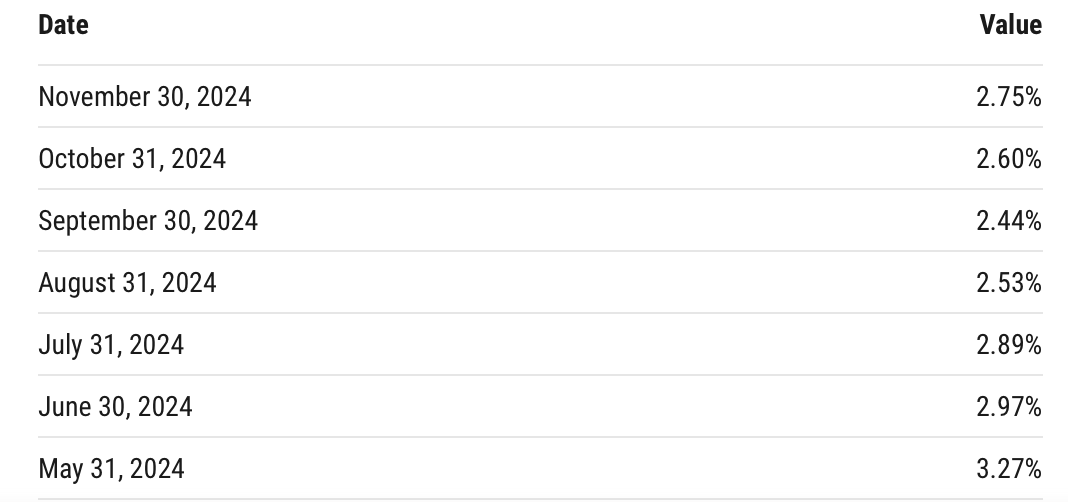
3) Inflation has come down but has started back up (see chart below). CPI is currently at 2.75%, but the Fed does not expect it to come down much in 2025. This is why Powell said they likely will only do two rate cuts in 2025. This means housing and auto affordability will not improve much in 2025.
4) The Federal budget deficit was around $2T in 2024 and is projected to be around that number in 2025. This means the US Treasury has to borrow $150 to $200B every month. Annual interest payments on the debt have jumped from less than $300B pre-COVID to over $1T. In 2025, interest expense is projected to be $1.3T.
5) Unemployment and jobs data appear to be stable, with the unemployment rate around 4.2% and new jobless claims well below recession levels. However, nearly all of the net new jobs created have been part-time for the last 12 months. And it is taking longer to replace full-time jobs. Anyone saying the jobs market is healthy is on hopium. It should also be stated that 50% of the new jobs were either government or healthcare (which is subsidized by government spending).
6) Retail and restaurants are not doing well, with a plethora of closings announced in 2024. Wal-Mart is doing well mainly because high-end shoppers are using it to buy groceries to save money. They are gaining retail share because of this phenomenon. But many shoppers feel like they are broke and are not spending.
7) GDP has remained strong, but this is mainly because it includes high government spending from our massive budget deficits. If the deficit were only $1T instead of $2T, we would likely be in a recession. Thus, we are printing GDP.
8) The stock market is overvalued mainly because it is attracting foreign investors, who now own about 40% of the equities. If you look at the total market cap size of the US exchanges vs the rest of the world, it is a staggering 60%. In 2010, it was only 30%, and a couple of years ago it was 40%. Can you say bubble?
9) Families have a cost-of-living problem. Essentially, their costs have risen faster than their incomes. Costs are not coming down, so to catch up, their income must outpace current inflation by a significant amount. If you connect the dots, you will see that most families are being squeezed into a lower standard of living and have less money for discretionary spending.
10) Housing valuations have started a trend downward. The median ATH was $436,000, and today it is at $407,000. This is mainly from higher interest rates (and lower affordability), but it shows a deterioration that is underway. Housing prices are dropping. This could put more pressure on consumers, who will have less equity to borrow against.
11) Rents have been sticky (after surging higher) because landlords have higher costs due to inflation. Insurance and service costs have risen substantially. For this reason, do not expect rents to drop substantially in 2025, and in most cities, they will remain flat (i.e., very high).
12) Banks’ stock prices have been doing well on Wall St, and they have had decent earnings. However, they have their share of problems with higher delinquencies on commercial real estate loans, auto loans, and credit cards. Plus, small business bankruptcies are on the rise. Banks are likely to be less amiable to credit expansion in the near term. Banks are a headwind on the economy that everyone seems to ignore.
13) Inflation is lingering. The government may say the CPI is currently at 2.75%, but we are feeling it with big increases in insurance and services, such as the plumber, auto repairs, or monthly subscription fees. Twitter/X recently raised their monthly premium subscription by 34%.
14) Our economic challenges over the past 15 years (and especially since 2020) are starting to catch up. We have not had a recession since the last one ended in June 2009. The business cycle has not been eliminated. Thus, the clock is ticking.
15) High interest rates have a lag effect, which has not yet been felt. Wall St seems to think this time is different, and the high interest rates won’t lead to a recession. There have been several economic indicators that have been triggered that usually imply a recession is coming. Some of these indicators have never been wrong before. This is why Warren Buffett is hoarding cash ($350B), and Jeremy Grantham is saying this is the most dangerous stock market he has ever experienced.
16) The DXY (the dollar index) is currently at 108, which is near the high for the year. This creates pressure on the bond market because foreign investors have to pay more to buy our debt. It also has the effect of exporting inflation, which irritates most of the world, who end up subsidizing our standard of living. At what point do they say enough?
17) The BRICS continue to expand, creating a Global South economic block that is a threat to US global hegemony and US dollar dominance as a reserve currency. While the BRICS have not announced a new currency, they are clearly considering creating one to compete with the US dollar. Russia does not want to accept Indian Rupees for their oil. They need a solution.
18) Oil prices have been down, currently trading around $70 bbl. This has put downward pressure on inflation. Gasoline and diesel prices have been a bargain of late. I don’t think we can expect oil prices to remain this low for much longer. At some point in 2025, I expect oil to go higher. This trend toward higher oil prices is likely to intensify as Texas begins to run out of tight oil wells to drill to offset the huge decline rate of around 50% per well.
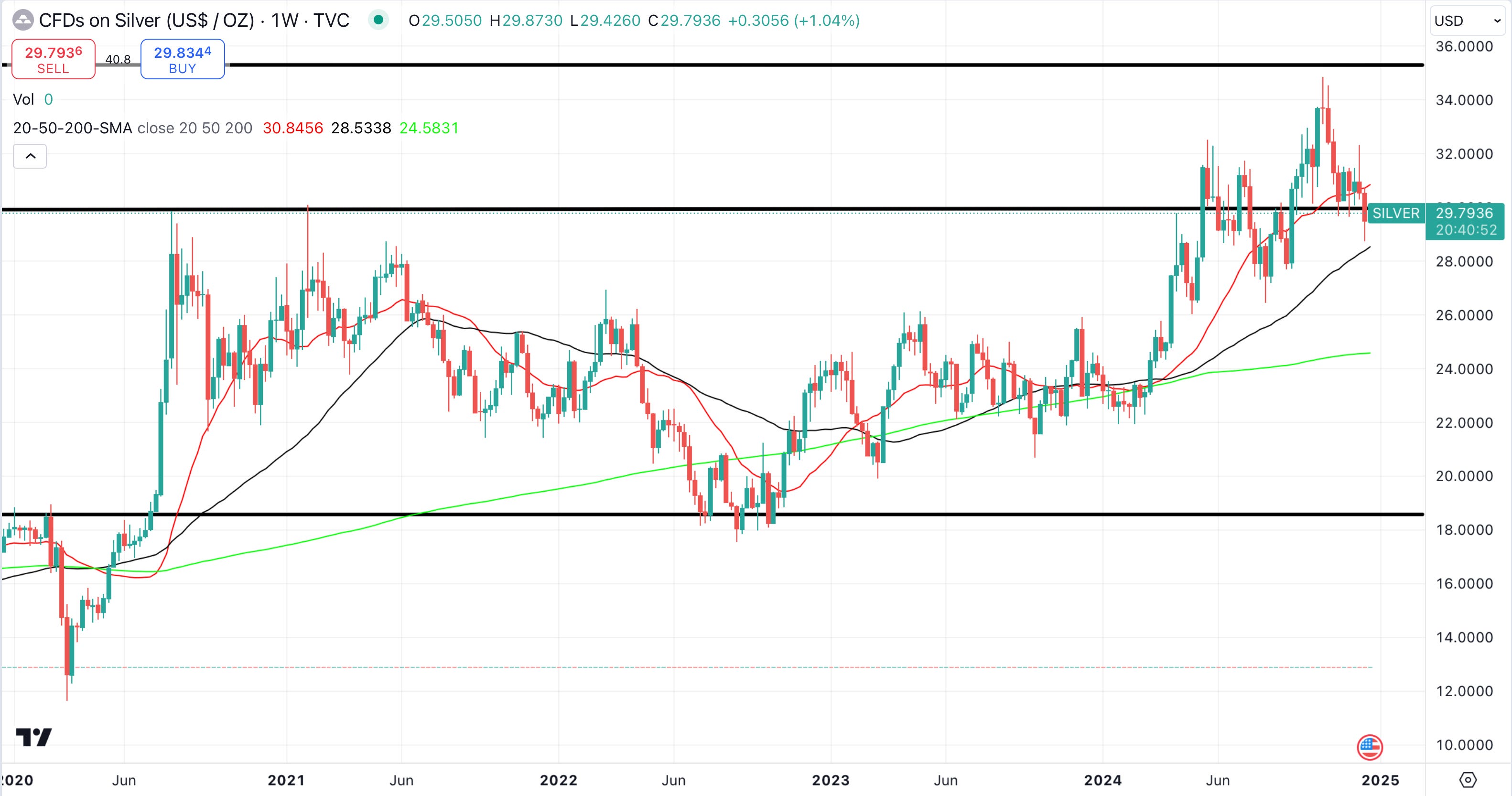
19) Silver has been volatile. It has repeatedly traded above and below $30 in 2024 (see weekly chart below). In October, it made an attempt to break out above the important $35 level, but failed to clear $35, and then fell back below $30, showing its weakness. I expected this false breakout because I don’t think silver can sustain a breakout until the bull market on Wall St ends.
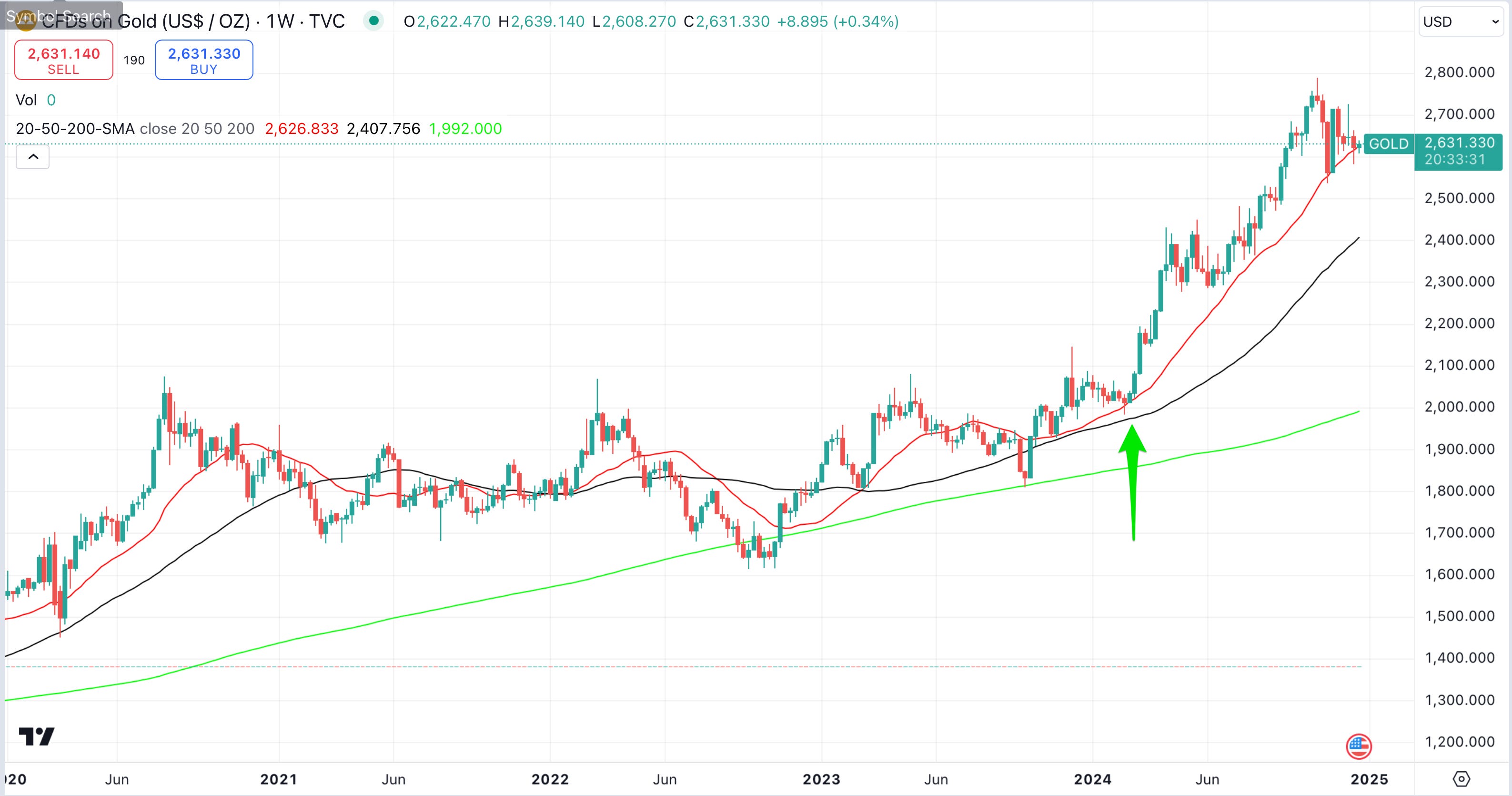
20) Gold has been strong since it broke out at $2070 in March 2024 (see chart below). In fact, it never retested that breakout level and likely won’t. It ripped from $2000 to $2400 from early March to early April and has never significantly corrected. It ran from $2000 to $2790 in October. Then corrected to $2536. That was a 9% correction. However, it has since bounced back to $2623 at year-end.
Why has gold been so strong with a so-called strong economy and strong dollar? Where is the demand coming from? A major buyer has been central banks. Why are they buyers? I think it is nervousness over the US economy, US government bond market, and the emerging Global South. There is a lot of uncertainty regarding the situation in the US. The irony is that the US stock market has attracted so much foreign money (which is ready to go home).
There is also economic uncertainty in other parts of the world. China has had trouble with its economy in 2024, with construction and housing finally losing their resilience. Japan has had problems, including a Black Monday stock market crash that caused a lot of concern. Japan has also had currency issues, with the Yen crashing versus the dollar. Europe and Germany have been on the verge of recession all year. So, the global debt bubble is causing heightened uncertainty and a reason for central banks to buy gold.
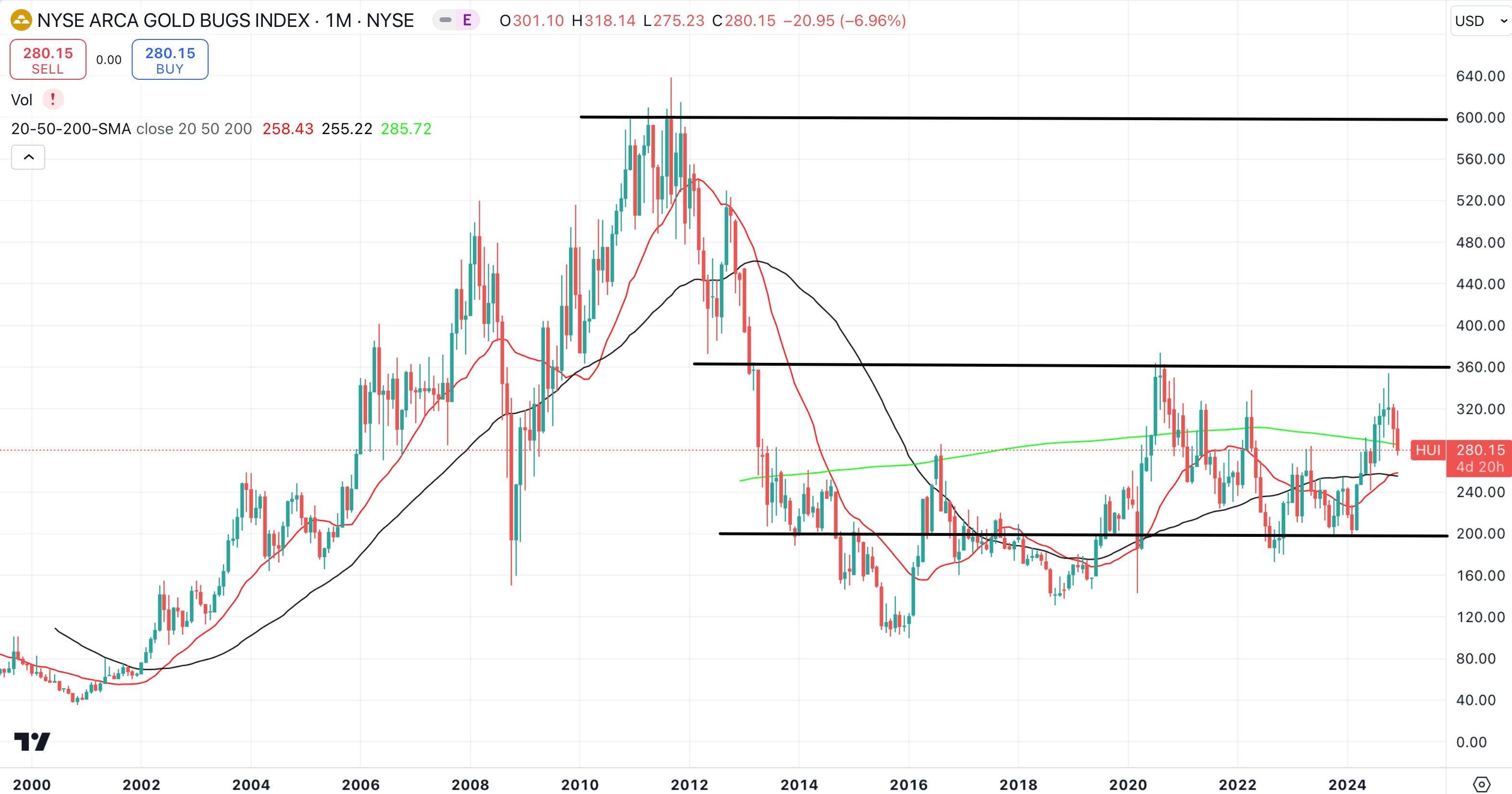
21) The HUI (gold miner index) has been a laggard (see chart below) and reveals that Wall St isn’t interested in buying gold miners. Both the silver and HUI charts reveal that they did not break out in 2024 with gold, but are still trying.
Newmont and Barrick have recently had solid earnings, but both of their stocks are selling nowhere near ATHs (all-time highs). Those two stocks are emblematic of the dearth of sentiment for gold/silver miners. Many of these stocks are leveraged to the hilt if gold/silver prices rise and sentiment returns. I expect both Newmont and Barrick to double in value if gold reaches $3000.
What to Expect in 2025
The only way gold/silver miners will have an excellent year in 2025 is if the economy falters and enters a recession. Gold/silver miners have only done well twice: in the 1970s and the 2000s. Those two eras both had something in common: economic problems.
The reason I have been bearish gold/silver miners (repeatedly calling them trapped) is because we don’t have enough economic problems (yet) to lift them higher. However, I do believe that economic problems are coming. In fact, I believe that once this recession begins, the US economy (in its current form) will not recover. Thus, it will be a very long, harsh, recession.
The US has allowed the debt bubble to get too big. The US is now trapped with only bad choices. From this point forward, the US government, US Treasury, and the Fed will now become reactionary, trying to keep the economy growing and to prevent a recession. However, that is impossible because a doom loop has already begun.
Once a debt bubble gets too big, there is only one outcome: default. That is where we are heading. Some say that we can push this debt bubble out another 10 years down the road and keep kicking the can. Perhaps, but I think we have already reached the end, and that end will soon become apparent.
The fact is, we have already been kicking the can since the early 2000s (and you could make an argument that our economic problems started in the early 1970s when President Nixon abandoned the gold standard). We have been living off debt and printing our GDP since 9/11 in 2001. Debt has been going straight up ever since, rising from around $6T in 2001 to $36T today.
We have been ignoring this debt explosion since 2001. Washington hasn’t even attempted to reel in its spending largess. In 2024, the budget deficit was $2T, and GDP grew at around 2.5%. Thus, we had economic growth, and Washington still spent money like drunken sailors. Do we really expect them to stop spending after nearly 25 years of largess? No chance, but that is now a problem because our interest expense has reached $1T and is rising.
The problems we have today are inflation, high interest rates, an out-of-control US government budget deficit, fiscal dominance, a slowing economy, and a strapped consumer. That combination has resulted in a doom loop.
Because of current fiscal dominance (the economy's reliance on government spending), the Trump Administration only has bad choices. Fiscal dominance demands that they continue to spend at record levels or else face a recession.
Here are Trump’s choices:
1) Cut spending. This will slow the economy and create a recession.
2) Increase spending. This will create inflation and create a recession.
3) Keep spending at current levels, and I hope the economy continues to grow. This might buy them some time, but inflation continues to create havoc.
4) Cuts taxes and raises tariffs. This is unlikely to negate their spending problem. The fiscal dominance problem won’t be easily solved.
The only way out of a debt bubble that is popping is a reset. However, a reset is never the first choice because it is too messy and not politically palatable. So, instead, they will do everything possible to kick the can and continue to expand debt. But once the recession begins, the choices only get worse.
It’s my expectation that a recession is coming and is inevitable. And once this recession begins, the doom loop begins. In other words, the doom loop is inevitable. And using game theory, it won’t be much longer before everyone figures this out, including Wall St.
Let’s play this out. The recession begins. What comes next? Most likely, all of the following, although not in this exact order.
1) Mass layoffs.
2) Economic growth stops.
3) The stock market crashes.
4) Foreign money leaves US assets (stocks, bonds, real estate, etc.) in droves.
5) The US government bond market has a big problem as foreigners dump their bonds and boycott our auctions.
6) The US dollar crashes.
7) Bankruptcies explode.
8) Regional banks begin to close. The FDIC cannot bail them out.
9) The Fed becomes feckless and cannot bail out everything that is coming unglued: banks, corporations, and bond markets.
10) The housing market crashes.
That is the likely outcome if a recession begins. When all of that is occurring, the US Treasury will attempt to borrow $150B to $200B a month. Who will be the buyers? Hint: The Fed is going to turn Japanese. The Fed will end up buying nearly all US government bonds. That will only work for so long, because this will be newly printed digital dollars, thereby creating inflation, and potentially leading to hyperinflation.
The Fed might be able to do that for about 2 years, but then it’s game over, and they will have to do a reset. My guess is that the reset will occur in early 2027, but I expect problems with the bond market to begin to appear in 2025.
I think my thesis is the reason gold has been so strong in 2024. Gold is sniffing out this outcome. The irony is that gold/silver miners are so cheap. Nobody seems to think the debt bubble will burst in the near term. Or else, the banksters know it’s coming but are content to ride the S&P 500 until the recession arrives.
I think the economy is much weaker than the GDP, consumer spending, and employment numbers reveal. I agree with Steph Pomboy, who said that the current stock market valuation is just air and that she is staying away from it. I also agree with Jeremy Grantham, who said this is the most vulnerable market there has ever been.
When the recession begins, I think the fear level will quickly exceed what was felt in 2008, and it was pretty frightening then. Fear and uncertainty are going to spin out of control very rapidly. That fear will ignite a fear trade into gold (and silver will follow).
So, what is the indicator that a recession has arrived? Technically, it is two quarters in a row of negative GDP. However, once the stock market crashes (and there is no bounce), everyone will know that a recession is coming.
So, as a gold/silver investor, the only number that matters right now is the S&P 500. Above 5500, and Wall St will remain bullish. Below 5200, and it gets interesting. Below 5000, and get out your popcorn.
So, until we see 5500, keep accumulating gold/silver miners and ignore the noise. Also, keep your eye on the HUI. I’ll be a buyer until we reach 350. I don’t know when that level will be reached, but we are likely a few months away. My guess is sometime in late spring. Normally, I don’t like to buy above 300, but I think this is the last opportunity to buy miners on sale.
Once the HUI is above 350, I will begin my exit strategy and sell to the top. The top for me will be $4000 gold and $100 silver. When we reach those levels, I will likely have sold 80% of my miners, and perhaps all of them. I see no reason to begin selling until $50 silver and $3500 gold. Those seem like conservative targets.
If I’m right, then 2025 should be an excellent year for gold/silver/miners. If I’m wrong, then we will have to wait until 2026. Ouch. Let’s hope that doesn’t happen.
So, here’s how I expect 2025 to play out.
Q1: More of the same, with the S&P 500 and gold remaining strong (the S&P above 5500 and gold above $2600) and everyone thinking we will get a repeat of 2024 (and no recession). But that is wishful thinking.
Q2: Once we get to Q2, we can expect the selling to begin and the 15-year bull market to end. The initial selling will impact gold/silver/miners, which each put in a yearly low.
Q3/Q4: By mid-summer, I expect gold/silver and the miners to be flying, as the fear trade finally arrives. The stock market will continue to trend lower and flounder.
Some investors expect the gold/silver miners to languish with the rest of the stock market, but that is not my expectation. Just refer to the 1930s and 1970s. The gold/silver miners did extremely well when the stock market was languishing.
Don,
When the markets finally break, do you see the same knee jerk reaction to cash as there has been in the past? Mass sell off including all metals and miners like we saw in the GFC?
At that time I has a solid position in Nevsun Resources. I sold at $2.00 and watched it drop below .30 cents. I did not buy back. I felt massively burned. In the rebound it shot to over $7. All I had to do was hold steady.
Do you see a similar scenario playing out?
Thanks
Celty
WOW! Scary Don but I'm all in.